THE SEVEN PLANETARY METALS, IN THE KEY OF SOLOMON
Every grimoire that asks you to make a thing eventually tells you what to make it out of. The Key of Solomon is unusually plain about it. One sentence, seven metals, no argument offered - the sort of instruction that survives four centuries precisely because it does not explain itself.
The list, in the text's own words
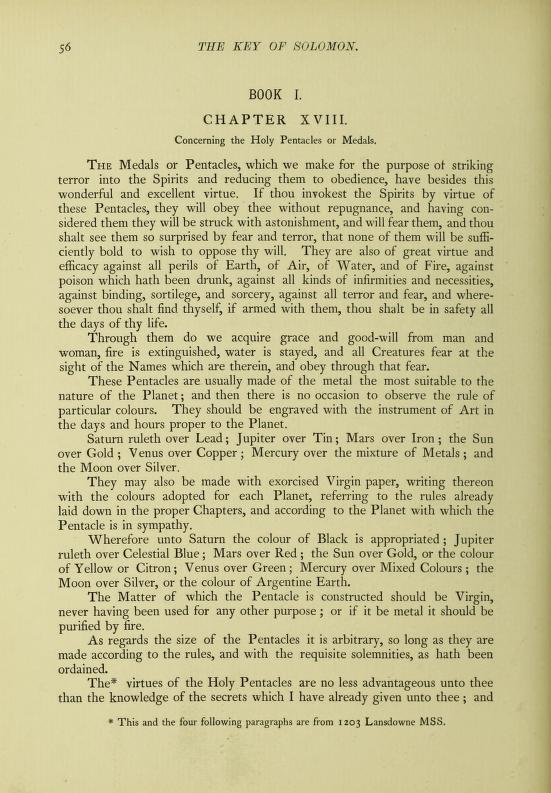
Saturn ruleth over Lead; Jupiter over Tin; Mars over Iron; the Sun over Gold; Venus over Copper; Mercury over the mixture of Metals; and the Moon over Silver.Key of Solomon, Book I (Mathers ed., 1889, public domain)
The colours follow immediately after, for anyone working on paper rather than metal:
Wherefore unto Saturn the colour of Black is appropriated; Jupiter ruleth over Celestial Blue; Mars over Red; the Sun over Gold, or the colour of Yellow or Citron; Venus over Green; Mercury over Mixed Colours; the Moon over Silver, or the colour of Argentine Earth.
Note what the text does not do. It gives no reason. It does not argue that lead resembles Saturn, or that copper is somehow Venusian in temperament. It states the correspondence as settled and moves on to the next instruction. That silence is worth sitting with, because the reasons offered elsewhere in the tradition were invented later and are usually mistaken for the source.
Rite, instrument, honest gap
Rite
The Key directs that a pentacle be made of the metal proper to its planet, or on virgin paper in that planet's colour, and engraved in the days and hours proper to the planet. Lead for Saturn, tin for Jupiter, iron for Mars, gold for the Sun, copper for Venus, silver for the Moon, and for Mercury a mixture of metals.
Instrument
One line of the list is straightforwardly astronomical in origin: the seven bodies named are exactly the seven that move against the fixed stars and are visible to the naked eye. There is nothing occult about that selection - it is what any careful watcher of the sky counts, and it is why the scheme has seven slots and not nine.
The metals themselves are the seven known to antiquity: gold, silver, copper, iron, tin, lead, mercury. Two lists of seven, both fixed by what the ancient world could actually see and smelt, are going to end up paired. Which pairing they chose is the historical question; that a pairing existed is close to inevitable.
Honest gap
Whether lead carries anything of Saturn is not a question any measurement reaches. The correspondence is a convention of the tradition, held for a very long time by serious people, and it remains a convention. We report the assignment, we can date it, and we stop there.
Anyone selling you a lead talisman on the grounds that the metal is Saturnine has left the text behind. The text simply says which metal to use.
Why the mixture for Mercury
The one entry that reads oddly is Mercury's: not a metal but “the mixture of Metals.” Mercury the metal is liquid at room temperature and cannot be engraved, so a plate of it is not a thing that can exist. The instruction is practical, not symbolic - the compilers needed something a craftsman could actually strike, and an alloy is what they reached for.
It is a small detail, and it tells you something useful about the document: it was written by people who expected the work to be done, not read.
Questions the sources get asked
Which metal belongs to which planet in the Key of Solomon?
Lead to Saturn, tin to Jupiter, iron to Mars, gold to the Sun, copper to Venus, silver to the Moon, and for Mercury a mixture of metals. The Key states this in Book I as a single sentence, without argument.
Do the planetary metals actually do anything?
Nothing in the text claims a mechanism, and no measurement supports one. What can be said is that the seven metals of antiquity and the seven visible moving bodies were both fixed lists, and pairing them was close to inevitable.
What if I cannot work in metal?
The Key allows it. It directs that the pentacle may be made on virgin paper in the planet's colour instead - black for Saturn, celestial blue for Jupiter, red for Mars, gold or yellow for the Sun, green for Venus, mixed colours for Mercury, silver for the Moon.
The Solomonic Guide sets the Key's own assignments beside the arithmetic we can actually check, and prints the part nobody can settle as exactly that.
The Solomonic Guide · $18.98